Introducing dogs to rabbits

I’ve introduced dogs to different rabbits  a few times now and luckily it has always gone well. However, the first 3 dogs were collies or collie crosses. Theo has been the first terrier I’ve tried this with. But as a friend said to me…staffies are terriers with a small ‘t’ unlike other terriers which have a high chase and kill instinct.

Breed and individual temperament is crucial when looking for a dog to live with rabbits. There are always exceptions to the rule but generally sight hounds (greyhounds etc.), spaniels and terriers don’t make the best companions for rabbits and other small furries.

I was prepared to try with Theo and was fairly confident as he was so young when we got him and because I know a few staffie owners that also have rabbits and guinea pigs.

Introductions happened in 4 stages:

Stage 1. With the rabbits in their run we let Theo out into the garden. He was initially very excited and ran around the run barking. My rabbits are used to dogs and therefore ignored him and did not run away. To stop him barking and chasing them I fed them so they stayed in one place and I scattered food for Theo around the outside of the run so that he could associate the rabbits with yummy treats (and they associated him with yummy food too). After a few days he got bored with them and ignored them completely when he went into the garden.

Yogi at Stage 1. Meeting the rabbits safely through the run. The rabbits have been rewarded with tasty food to encourage a positive association with the dog for them.

Yogi at Stage 1. Meeting the rabbits safely through the run. The rabbits have been rewarded with tasty food to encourage a positive association with the dog for them.

Stage 2. With Theo, stage 2 lasted about 7 weeks and will depend totally on each individual dog. With our other dog Yogi this stage never even happened as he has no chase instinct at all. With Theo this stage involved the rabbits being free range in the garden (they get a lot of free range time every day) with Theo on the lead. Every time Theo needed the toilet we took him out on the lead. That way, the rabbits could run around him and he could get used to them without chasing. If he showed interest in chasing them we gave him the command ‘leave it’ and as soon as he turned his head towards us he was rewarded. (We used clicker training so that we were more precise with his training and the ‘leave it’ command).  He was also rewarded for ‘good’ interactions such as sniffing them gently (or them sniffing him) or ignoring them when they hopped passed him.

Stage 3. This stage occurred simultaneously with stage 2. We took Theo to puppy training classes and learnt how to teach him ‘leave it’. This was practiced every day asking him to either leave a tasty treat or even to leave the cat!

Stage 4. After weeks of being in the garden on the lead, Theo was allowed off to roam around the garden free with the rabbits. We always go outside with him and initially I always took treats so that if I needed him to come back he would get rewarded. Now we are in May (we got him in January) he can go out to the garden with the rabbits and although he is always supervised by us, we don’t need treats all the time to get him to come back.  He is now more interested in the rabbit food or rabbit poo to take notice of what they are doing and likewise they aren’t bothered by him.

Yogi & Theo with Daisy and George. May 2015

   Yogi & Theo with Daisy and George. May 2015
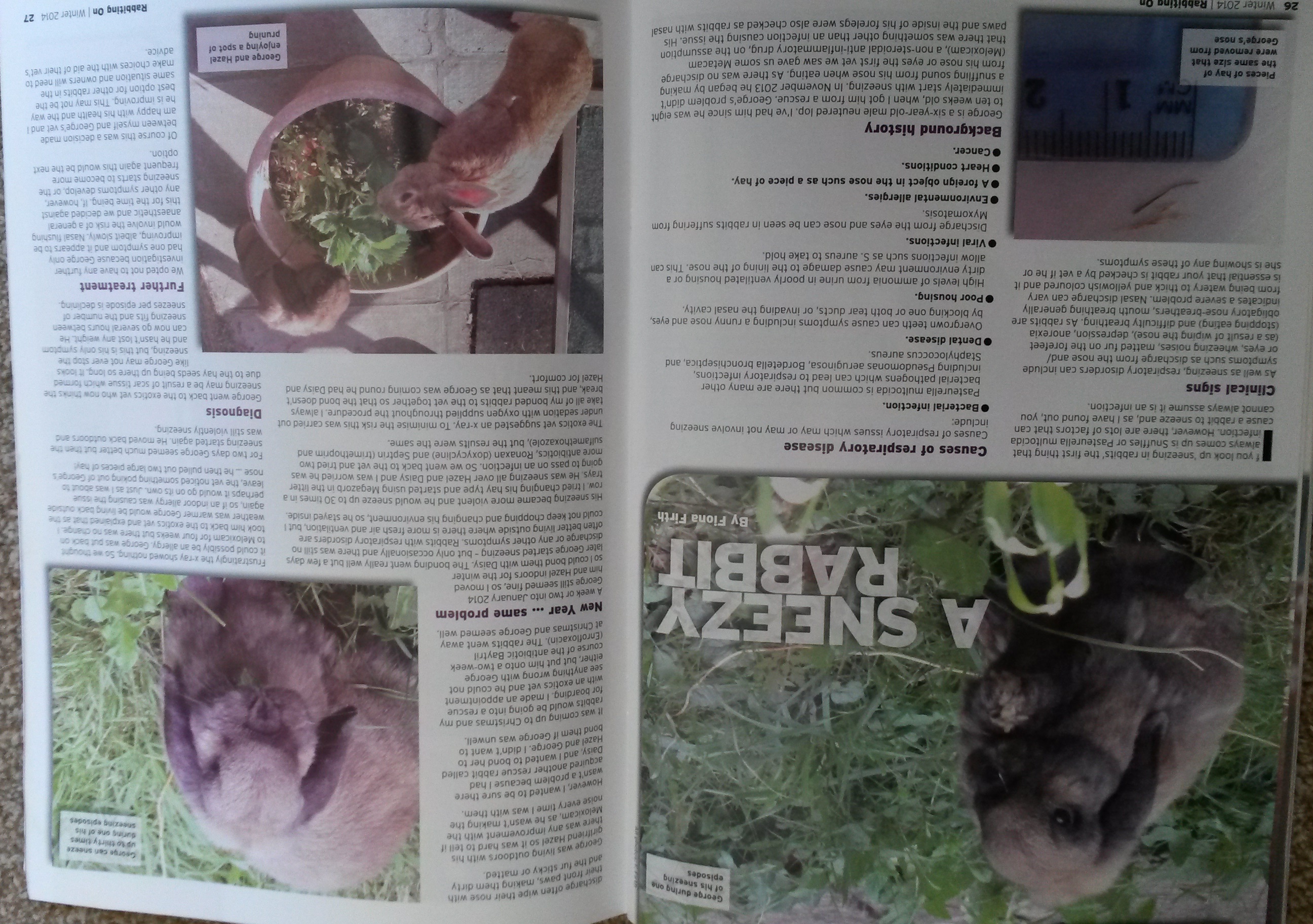
Chronic sneezing

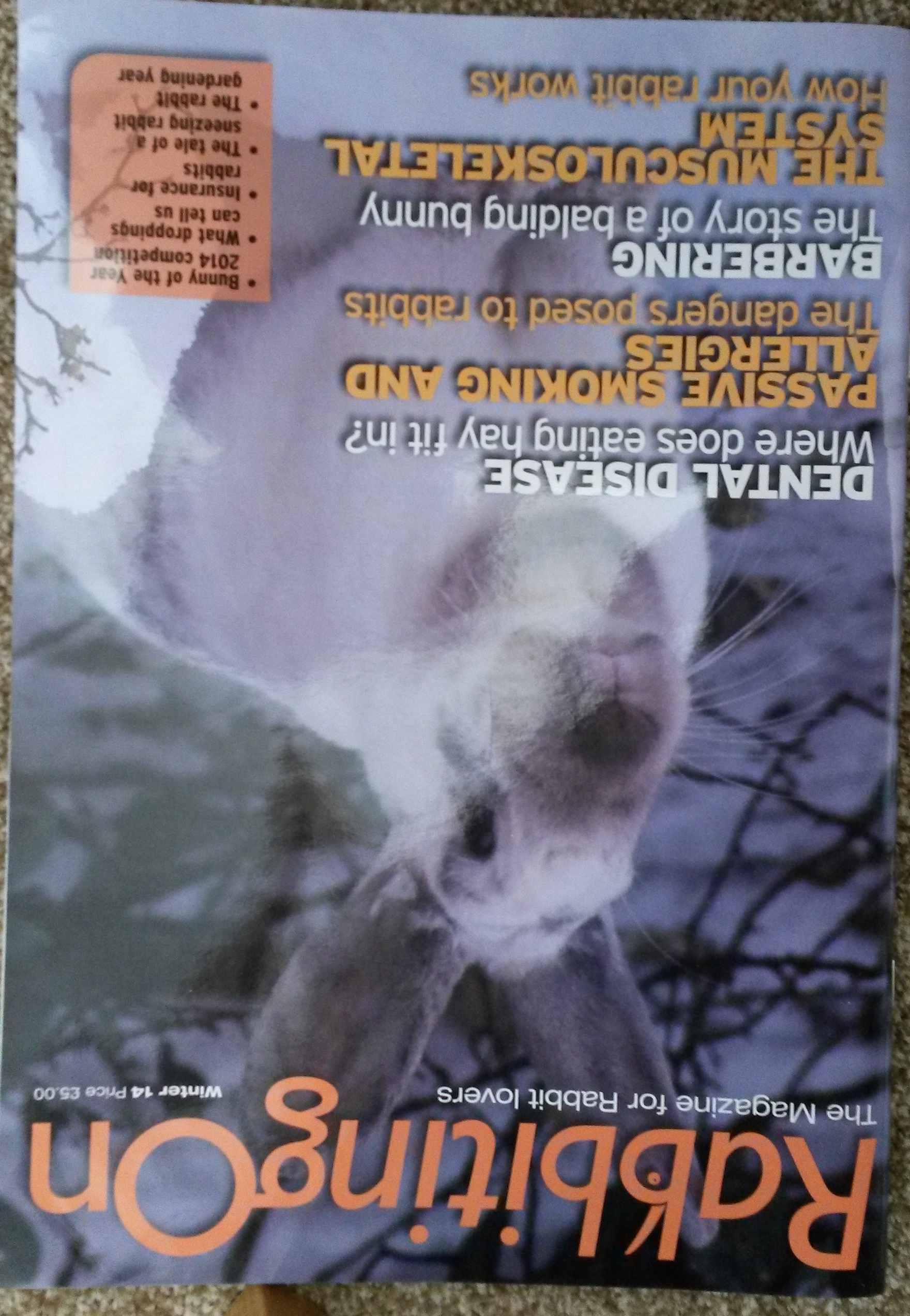
George started sneezing in November 2013. It’s now April 2015 and he is still sneezing. His story was published in the Winter 2014 edition of Rabbiting On (an excellent magazine that you receive quarterly if you’re a member of the Rabbit Welfare Association & Fund). At the time of publishing we had tried several different types of antibiotics, changed his environment and the litter being used in the trays, had an x-ray and pulled some hay from his nose. However, nothing seemed to help.

sneezy 1 sneezy 2

In November 2014, I decided to take him to Great Western Exotics Vets (yes, rabbits are classed as exotic pets!) where he spent a day having a few procedures. I took Hazel and Daisy (as I always do) to keep him company and made sure they all had their favourite tasty food ready and that the staff knew they liked water out of bowls not bottles. Due to the fact he has a respiratory problem he was sedated as it was too risky to anaesthetise him properly. He had a CT scan (expensive! lesson learnt about getting insurance) and swabs of his nose were taken.

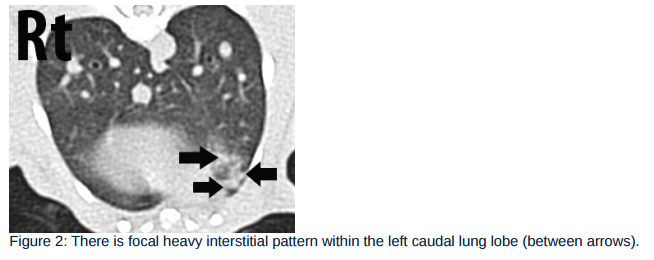
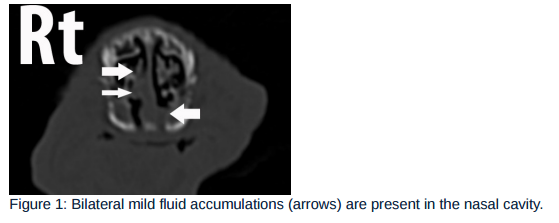
A few days later we had the results of the CT scan and swabs. His nose did show fluid but the swabs could not pinpoint any single pathogen so we were still none the wiser regarding what drugs to use. He had a mark in his lungs which possibly pointed to a previous issue such as pneumonia and a dental spur was also found but as George is still eating and not losing weight we just have to keep an eye on him. He is a poor hay eater in comparison to the girls so I have to be careful not to give him too many tasty things or he refuses to eat the hay. What I wasn’t prepared for was that he had infections in both his ears (poor man) and a polyp in one ear. The vet explained that lop eared rabbits are basically the Pug’s of the rabbit world (bred for looks rather than health) and their flat faces and floppy ears cause all sorts of problems. Lop eared rabbits many more problems because the air cannot circulate and dirt gets trapped inside them. We were given more antibiotics, a mucolytic (Biosolvon) to try and get him to sneeze out the stuff in his nose and some ear drops. The vet also advised ALL owners of lop eared rabbits should ear clean regularly (once or twice a week). A check up after two weeks showed his ears were clear again.

Lung CT scan

Lung CT scan

I was given other options to try and establish what was in his nose. This included more nasal swabs or a fine needle aspiration into his lung. Unfortunately, both meant risky anaesthesia and there was no guarantee that we would get a definitive answer. I opted not to put him through any more procedures.

CT scan right ear

CT scan right ear

CT scan nose

CT scan nose

Several months later (the sneezing never stopped) and I felt that his breathing sounded a bit ‘snotty’. We went back to the vets in March 2015 where he confirmed his lungs were clear (good news) but that he did still have issues with his nose. We got more antibiotics (penicillin this time) which I had to inject daily for 14 days and the vet suggested a nebuliser to manage the problem as at this stage it is a chronic condition. He gave me some F10 disinfectant mixed in distilled water and I bought a nebuliser from here. I highly recommend this company as I ordered Thursday morning and it arrived Friday morning (and was much cheaper than the website the vet suggested). You can also get nebulisers from Boots and other online chemists. Here is a video of George and his nebuliser, as you can see it doesn’t bother him much. To start with he was getting nebulised twice a day for 20 mins, then we reduced to once a day and now it’s a few times a week. Fingers crossed we can manage it and he will live a long life yet.

Dead -nettle – free food for rabbits

There’s some Purple Dead-nettle (Lamium purpureum) growing just outside our garden gate. It’s not something I’ve ever offered to the rabbits before because I’ve heard it has quite a bitter taste (especially once flowering). It is however, a safe wild plant for them to eat. Dead-nettle is also a favourite food for bees early in spring so I’m not keen to deprive them.

Dead-nettle can be found in red/purple or white (Lamium album) and does not sting like the common nettle. Like the stinging nettle it is however edible and can be used in salads, stir-fry and soups for humans.

Out of curiosity I picked a couple of stems and offered them to Daisy and Hazel. They must have decided they were delicious because this started a bit of a squabble and the Dead-nettle was gobbled up in seconds.

20150407_170845 20150407_170906